)
Drought, low rivers and industrial water management in Europe
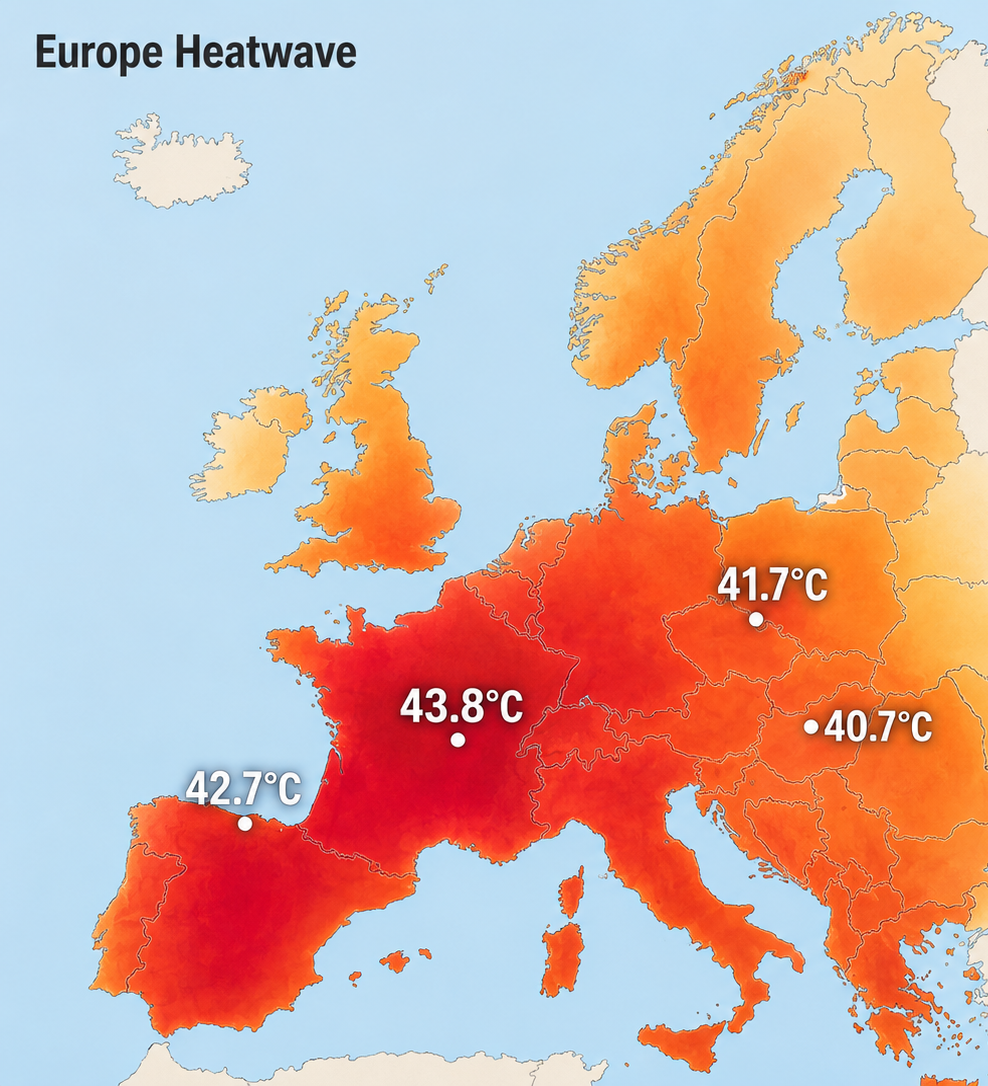
Europe has entered the summer under exceptional heat stress. Temperatures close or even above 40 °C have been measured in many parts of southern and western Europe, and new June heat records have been reported in several countries.
This is not only a public health or agriculture issue. Heat and drought also affect industries by reducing water availability, cooling capacity and the natural dilution capacity of rivers receiving industrial discharges.
Last year was already a warning
The 2025 drought season showed how vulnerable European industry can be to low water levels. Germany had its driest March on record, and some Rhine water levels were around half of normal. Low water restricted shipping capacity, forcing vessels to sail with reduced loads. This increased transport costs and created supply-chain risks.
But this is not only a Rhine shipping issue. France faced local water restrictions in 2025, with some regions under crisis-level drought conditions. Italy’s Po River has also shown how quickly river flow can fall during heatwaves, allowing saltwater intrusion and forcing irrigation restrictions.
These are warning signs for all water-dependent sectors.
Water availability is becoming as important as water quality
Industrial water management has traditionally focused on water quality. That remains essential, but drought adds another constraint: availability.
Steel plants, metal refineries, chemical plants and mines all depend on water for cooling, process circulation, gas cleaning, dust control, washing, flotation, leaching and wastewater treatment.
When river flows are normal, industrial intake and discharge volumes may represent only a small fraction of the receiving water body. During drought, the same intake may become a significant share of available water, and the same discharge has much less dilution capacity.
This makes drought both a water quantity and water quality issue.
Why low river flow matters for discharges
Low river flow changes the operating environment in three important ways.
First, dilution capacity decreases. The same discharge load can lead to higher local concentrations of metals, salts, nutrients or other contaminants when the receiving river has less water.
Second, the system becomes more sensitive to process disturbances. A short concentration spike that would normally be diluted may become more significant during low-flow conditions.
Third, operational flexibility becomes tighter. Sites may need to recycle more water, reduce discharge volumes, adjust treatment chemistry or temporarily limit certain operations. Permit compliance can also become more difficult, especially when limits are based on both concentrations and total loads.
Low flow often also comes with higher water temperatures and lower oxygen levels. This makes receiving ecosystems more vulnerable to additional industrial loading.
Central and Southern Europe: different industries, same water pressure
In Central Europe, steel and metal refining are especially exposed. These industries are often located along rivers for logistics and reliable water access. Water is used in critical cooling, gas cleaning, slag handling, surface treatment and hydrometallurgical processes.
In Southern Europe, the same pressure appears in mining. Spain and Portugal are important for Europe’s raw material supply, but mining operations require water for mineral processing, tailings management and dust suppression.
Unreliable water availability drives industries toward closed-loop water reuse. This is necessary, but it also creates new challenges. Water quality in reused process water tends to change over time, which can make processes unstable and increase operating costs.
Drought makes industrial water management more dynamic
Under stable conditions, many sites can rely on fixed sampling routines, laboratory analysis and established treatment recipes. During drought, this may not be enough.
Water chemistry can change quickly when process water is recycled more intensively, evaporation concentrates salts and metals, intake volumes decrease, treatment plants operate closer to their limits, and receiving waters lose dilution capacity.
This means industries need better situational awareness. They need to know what is happening in their water streams early enough to react.
How fast dissolved metal data can help
Fast dissolved metal monitoring cannot create more water. But it can help industries use and manage available water more intelligently.
Fast data can help to:
Control water circulation by following metal accumulation in reused process water
Improve treatment performance through faster feedback on dosing, pH and removal efficiency
Detect abnormal metal spikes before they reach discharge points
Support more confident discharge decisions during low-flow periods
Reduce unnecessary over-treatment and support lower-cost environmental performance
In drought conditions, the margin for error becomes smaller. Faster data gives operators more time to act.
Outlook: industrial water management must become more resilient
Drought is becoming a practical business issue for European industry.
For steel and metal refining in Central Europe, low rivers can affect logistics, cooling, process water and discharge management. For mining in Spain, Portugal and other dry regions, water availability may become one of the defining constraints for project development and daily operation.
Europe needs industrial production and raw materials. But future operations must be more water-smart, more data-driven and better prepared for low-flow conditions.
Water availability may become as important as water quality. When both are constrained at the same time, fast and reliable monitoring becomes an operational tool, not just an environmental reporting method.