)
Between lab samples, your steel mill water chemistry keeps shifting
Rapid dissolved-metal analysis for cooling, blowdown and pickling streams
Application insight for integrated steel mills and EAF operations
Steel plants rely on large volumes of recirculated process water across cooling, scrubber, casting and rolling circuits. Water quality is typically managed through scheduled chemical dosing and periodic laboratory sampling.
In practice, process water chemistry is not stable. Dissolved metal concentrations shift continuously due to evaporative concentration, scrap composition, upstream process variation, and seasonal effects and metals accumulate in ways that are rarely caught between lab cycles.
When these shifts go undetected, the first sign is often a problem: a forced outage, or a compliance exceedance at the discharge point.
Three areas where dissolved metals create hidden operational risk
1. Environmental compliance. BAT-AEL conditions on zinc, chromium (Cr(VI) especially), nickel, manganese and iron are tightening across European steel sites, with compliance deadlines through 2026–2029. Without faster visibility, a permit exceedance can occur before it is detected.
2. Water recycling stability. Closed and semi-closed loops progressively accumulate dissolved metals from corrosion, scrap chemistry and process contacts. Concentrations can reach levels that affect downstream operations or treatment systems.
3. Equipment integrity. Elevated dissolved iron and zinc accelerate corrosion in pipework and heat exchangers, shortening equipment life and driving more frequent unplanned maintenance.
Where the metals come from
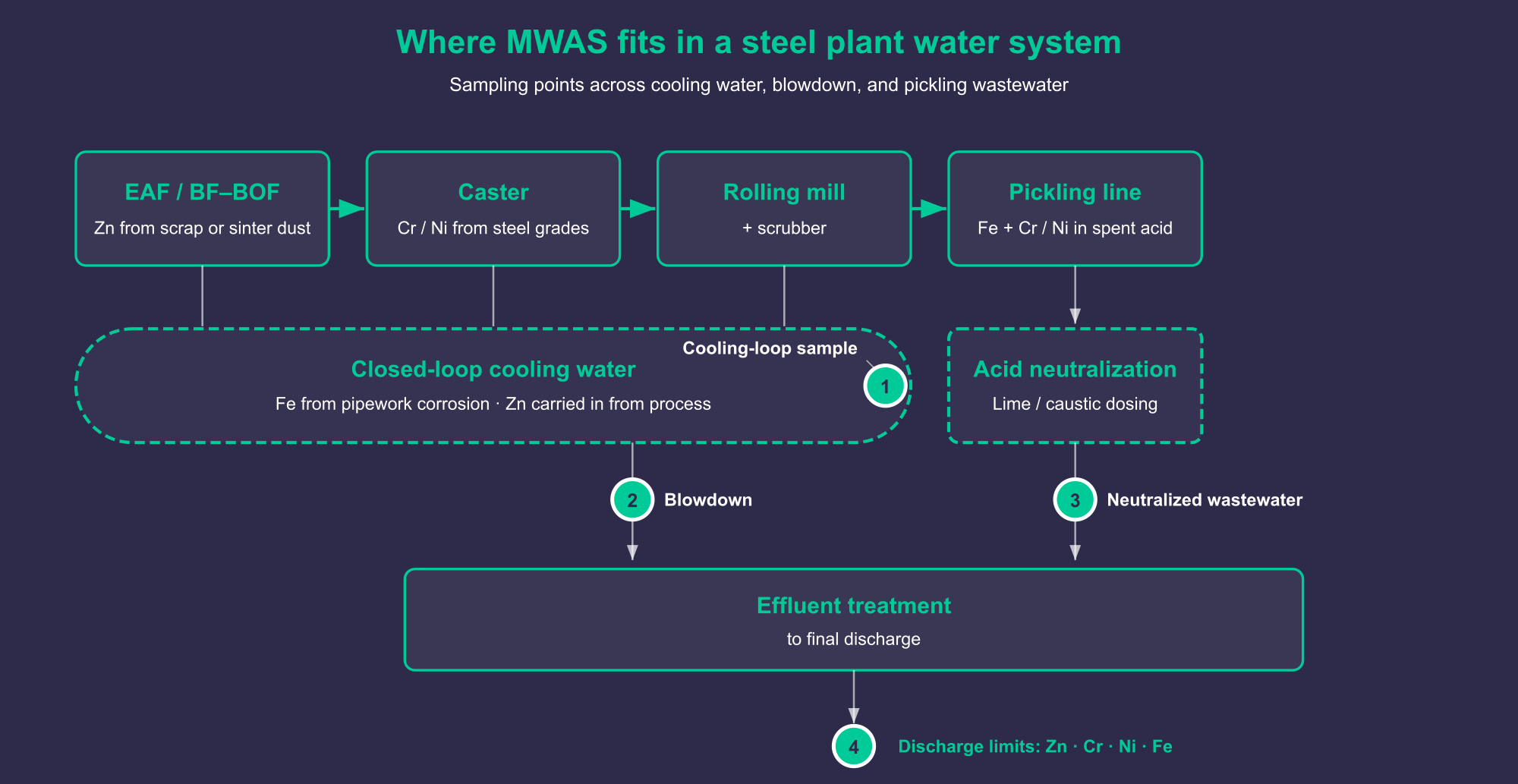
The process water system is exposed to many dissolved metal sources. Galvanised scrap introduces zinc in EAF operations, corrosion of pipework adds iron, alloying elements bring chromium, nickel and manganese in through process contact, and pickling lines contribute Fe, Cr(III) and Cr(VI) that stay measurable in neutralized wastewater. In integrated mills, blast-furnace gas scrubber circuits also accumulate dissolved metals from sinter dust and process gas.
These metals do not remain passive. Zinc accelerates under-deposit corrosion; chromium and nickel accumulate in blowdown and effluent, with Cr(VI) typically held to tighter permit limits than Cr(III).
The cost of finding out late
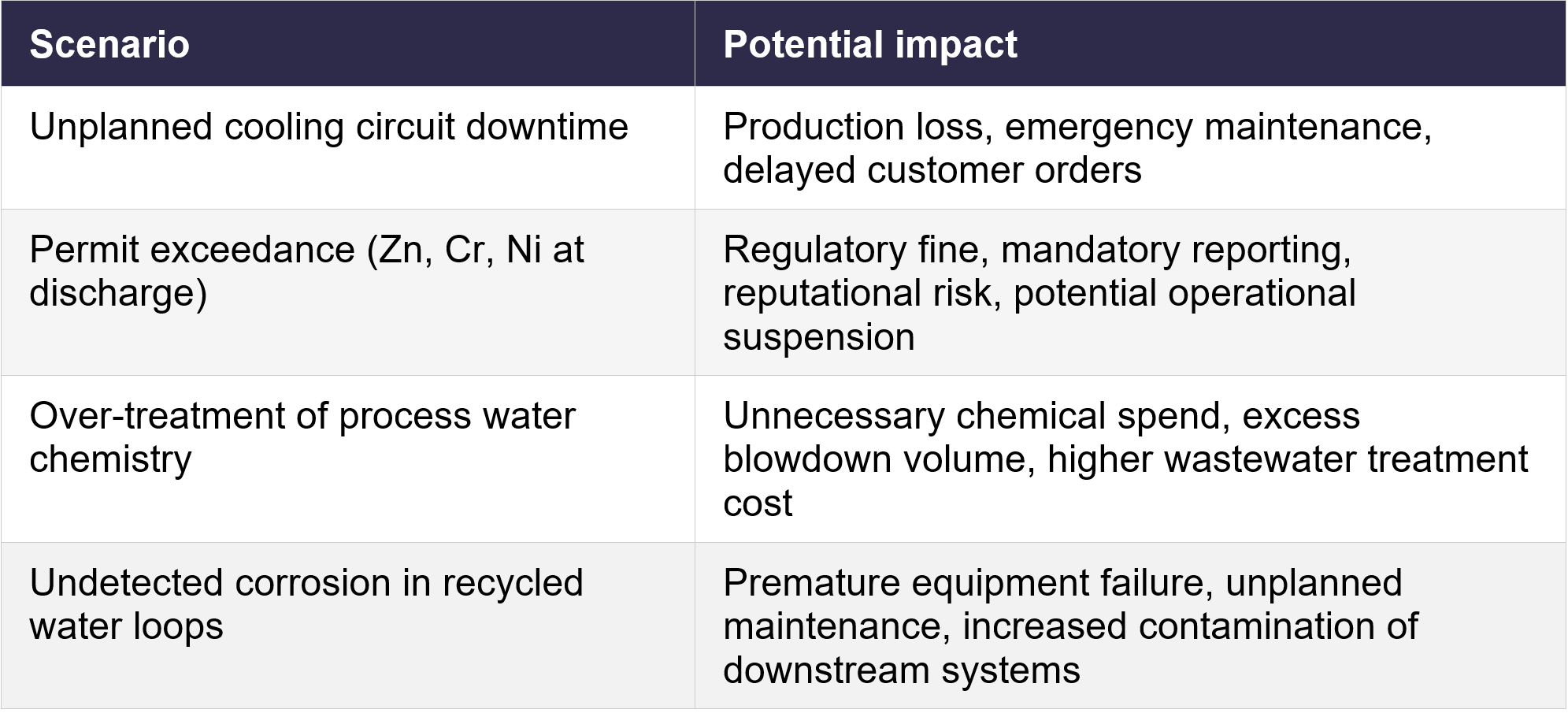
When dissolved metal concentrations shift without early warning, responses are reactive: chemical dosing is increased as a precaution, and discharge sampling is intensified after an exceedance is detected.
Each has a direct cost. The larger risk is the unplanned event, an unexpected cooling outage on a continuous caster or blast furnace circuit, or a compliance notice that triggers a mandatory operational review.
Faster than the lab cycle
Instead of relying solely on periodic laboratory sampling, steel operations are starting to look at faster visibility into dissolved metal concentrations directly in process water.
3AWater MWAS (Multimetal Water Analysis System) provides rapid dissolved metal analysis across multiple process streams, designed for industrial environments where laboratory turnaround is too slow to support same-shift decisions.
With faster insight, it becomes possible to:
detect changes in dissolved zinc, iron, chromium (Cr(III) and Cr(VI) measured separately) and other metals before they reach critical thresholds
link water chemistry variation directly to corrosion risk and chemical dosing decisions
manage blowdown and water recycling decisions based on actual measured concentrations, not fixed schedules
build a frequent, time-stamped record of dissolved metal results, useful in permit reviews and BAT-AEL audits
baseline a new discharge profile during DRI-EAF or other process upgrades, by sampling more often, more quickly, than the lab cycle allows
Where this fits best in steel
In the steel sector, immediate interest is in blast furnace and EAF cooling circuits, continuous caster water systems, neutralized pickling wastewater, and final effluent treatment, particularly where Cr(VI), zinc and nickel permit conditions are tightening.
Let’s discuss
Every steel plant operates differently. If you are preparing for a BAT-AEL review, or dealing with fast variations in your water systems, we would be glad to exchange experiences.
Contact tuomo@3awater.com or Book a meeting.