MWAS Monitor: From water quality measurement to operational control
MWAS Monitor software connects measurements, quality control, alerts and operational actions in one system.
Water-quality data creates value only when it leads to the right action at the right time. That is the idea behind MWAS Monitor, the software layer we are developing around fast dissolved-metal analysis and industrial water-quality monitoring.
Our Multimetal Water Analysis System (MWAS) already provides dissolved-metal results on-site in minutes. But getting the result is only the beginning.
The next questions are: Can we trust the result? Does it require action? Who needs to know? What should happen next? And where should the data go?
From measurement to control
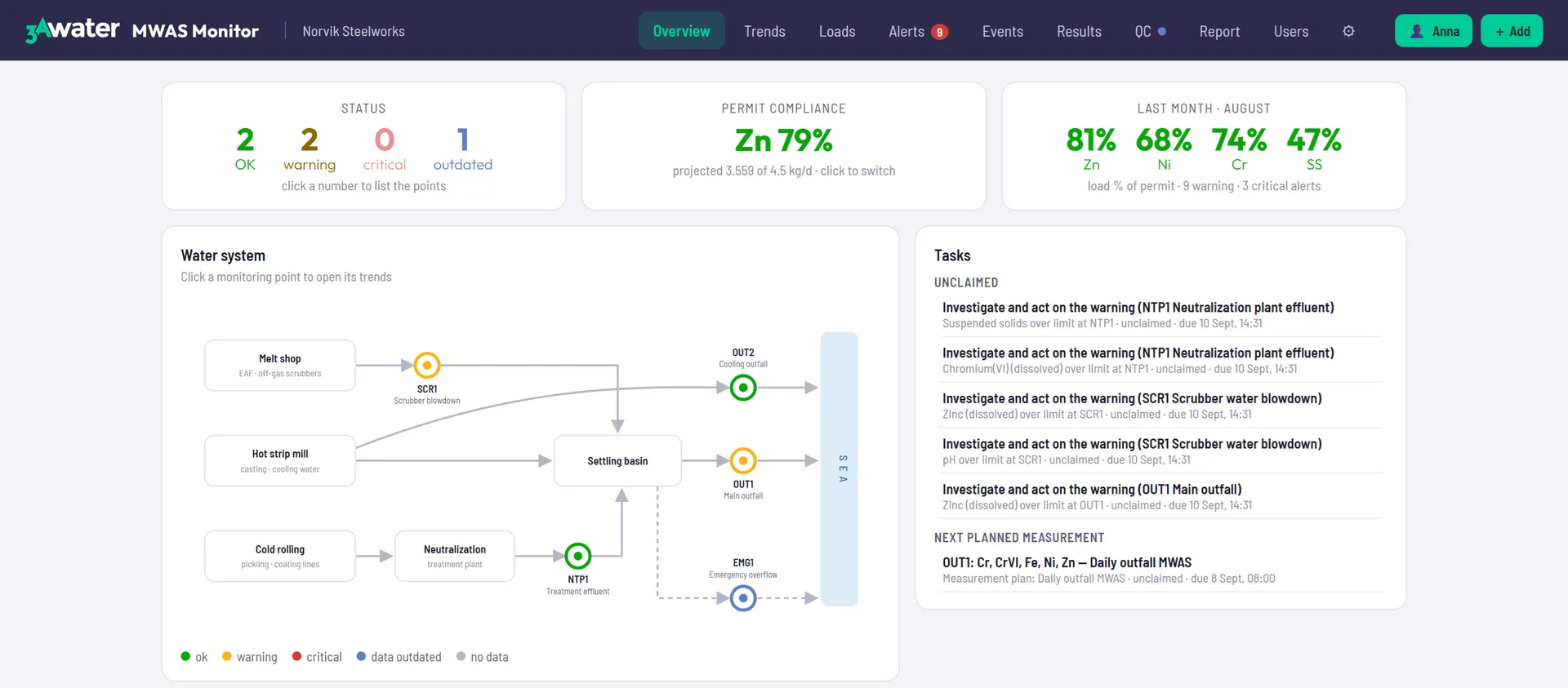
We are now testing MWAS Monitor with our first customers. During the pilot, the system gives us and the customer a shared view of what is being measured, how the analysis is performing and what is happening at different monitoring points.
For us, this is also valuable during customer pilots. We can follow how the system is being used, identify analytical or operational issues faster and support the customer remotely.
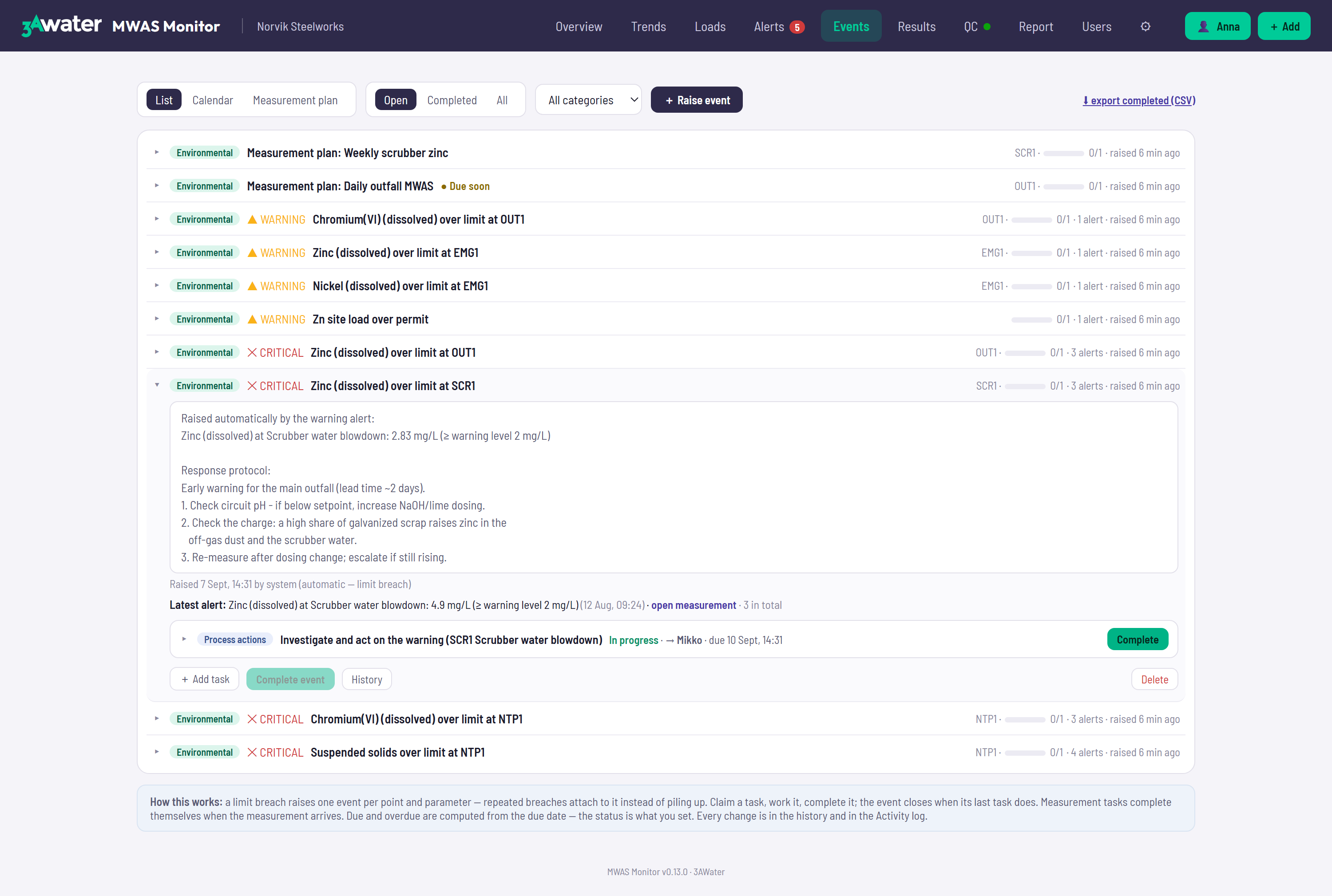
MWAS Monitor currently brings together functions such as:
status and trends from different monitoring points
warning and action limits
automatic alerts when attention is needed
measurement planning and reminders
response actions and responsible people
permit and internal load monitoring
records of measurements, alerts and actions
analysis quality control and validation measurements
The aim is not simply to create another place to view data but to help turn water-quality measurements into controlled and repeatable operational processes.
Monitor can also work behind the scenes
Our first customer discussions have also highlighted something important: Not every industrial site wants another software platform.
Many larger industrial sites already have established process, environmental or data-management systems. In those cases, MWAS Monitor can have a different role. It can work as the quality-control and communication layer around the analysis:
MWAS measurement → analytical QC → limit check → alert if needed → validated data transfer to the customer's existing data platform
The customer can continue using its existing system as the main operational interface, while Monitor helps ensure that the measurement is reliable, documented and transferred correctly. This is becoming an important part of how we see the product developing.
More than dissolved-metal analysis
Fast dissolved-metal measurement remains the foundation of our solution. But our objective is broader: Help industrial sites use water-quality information to improve water treatment, discharge control, process-water management and operational decision-making.
For some customers, this may mean using MWAS Monitor directly as their water-quality control interface. For others, it may mean using Monitor mainly for analysis QC, alerts and integration, while the results are transferred to an existing historian, environmental database or other operational system.
Both approaches solve the same underlying problem: Getting reliable water-quality information to the right people and systems quickly enough to act.
We are looking for users and integration partners
MWAS sits between two worlds. Continuous measurements such as pH, flow, conductivity and tank level typically connected directly into the process automation system.
More detailed chemical results often come from the laboratory and may stay in Excel, LIMS or reporting systems. MWAS can produce chemical data faster and more frequently. For example, a water-treatment plant could measure dissolved metals five times per day at the treatment inlet and outlet. That is already frequent enough to adjust treatment during the day and compare metal concentrations with pH, flow, dosing and other process parameters.
Our question is: Where should this data go to create the most value?
Should MWAS results be connected to the process automation system or its process-data database, where operators can compare them with other process parameters? Should they go into a LIMS or environmental data system?
What kind role our MWAS Monitor should have there? Stand alone water quality management software or QC and data transfer layer
We want to understand how water-quality data is managed today, where the current process creates delays or extra work, and which existing systems we should connect to first.
If you work with industrial water management, process automation, laboratory systems or industrial data platforms, we are interested in hearing how this works at your site.
Contact us to discuss a pilot, integration or co-development opportunity.